

Return it better
My grandfather's wisdom that makes me a better leader

If/when you leave, it should be better than when you found it. And it’s been better.
My colleague’s words tugged at my heartstrings — not only because of the profound compliment in her words, but also because of the childhood memory they surfaced.
I was helping my grandfather cut the grass when the lawnmower stopped working. It wasn’t a problem that his initial tinkering could fix, so he asked his neighbor to borrow their lawnmower so we could finish the job. Borrowed lawnmower in hand, I finished mowing and then started to return the lawnmower to the neighbor.
Where are you going with that?
My grandfather’s scolding voice caught me by surprise. I thought I was being helpful.
It’s filthy. Bring it over here and clean it up before you bring it back.
The mower was filthy when we borrowed it, I protested.
My grandfather looked at me directly and insisted.
When you borrow something, you should return it better.
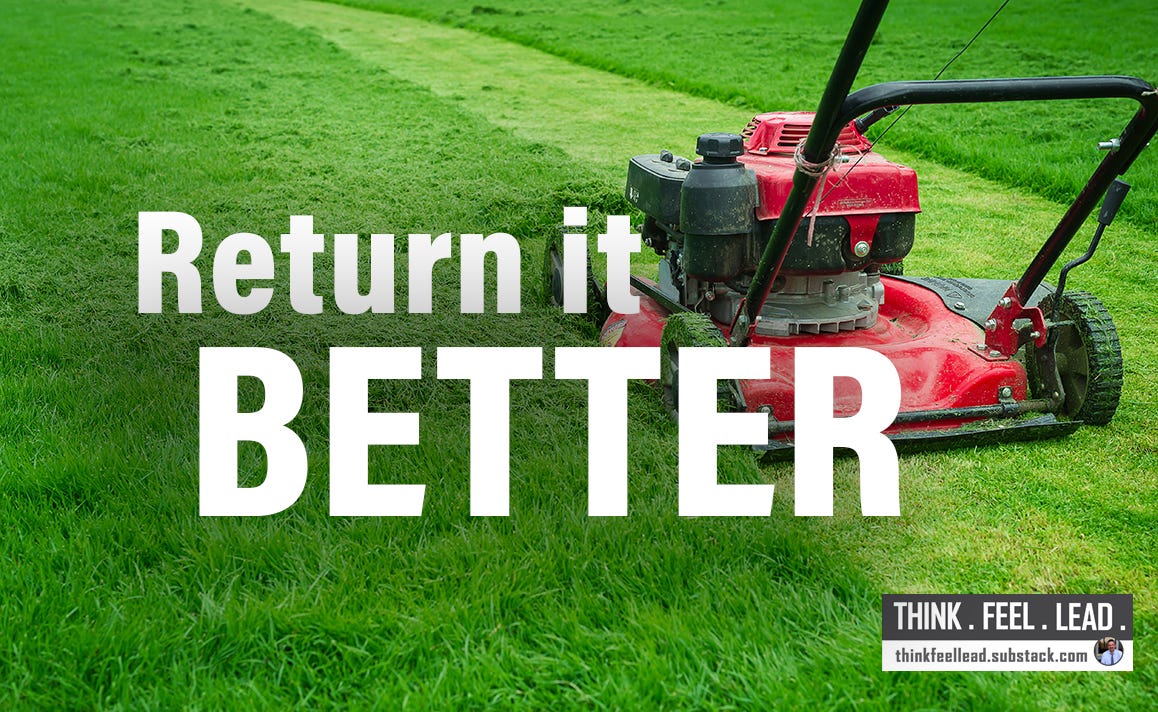
I had a long time to let his words sink in, because his definition of better was brand new. When it finally passed his inspection, that mower didn’t have a speck of grass, dirt, or oil on it — and I had a lesson that would stick with me for the rest of my life.
When we walk into a new environment, whether it be a conversation, organization, or someone’s life, we should strive to enrich it by our presence and actions and return it better when we inevitably leave.
How do we do this as leaders in organizations? I have five approaches that have worked for me.
Listen to understand and learn. When we’re new to a situation, there are likely others who know more than we do. We need to listen to them to build a solid understanding of the current state, including all the political, cultural, and historical reasons why things are they way they are. In very practical terms, we can’t make something better without understanding it first.
Ask for — and use — feedback. There are things that we’ll do well, and places where we’ll make mistakes. Most of us are notoriously bad at having a full view of either without asking for honest, constructive feedback from others. How often do we earnestly ask how am I doing? to those we lead? Asking for feedback regularly and using it to adjust course can be critical to avoiding unintentional derailments of our efforts to improve.
Measure and celebrate improvements. How do we know we’re making it better? Measure, measure, measure. When we establish our baseline conditions and identify a desired future state, we can then measure and celebrate our progress along the way. I’ve been amazed at how quickly we can adapt to a new normal and forget how far we’ve grown from the baseline. Both measurement and celebration remind us of our improvement.
Build lasting structures and culture. Earlier in my career, I had a bit of a savior complex — the selfish notion that I was the solution to every challenge. Even in the unlikely event this was true, it’s unsustainable. We can only return it better if we can walk away and have the improvements last. We have to build structures and culture that can persist without our presence — and this involves building both collaboratively so that no one person underpins or owns the whole thing.
Focus on people more than process. In my experience, this is the most critical piece. It’s hard to think of any organizational change where the impact — positive or negative — doesn’t fall squarely on people. What do they gain? What do they lose? How do they feel as a result of your presence and actions? A focus on people requires that we see them as humans rather than resources. It’s nearly impossible to individually maximize the impact of change on each person (especially in large teams and organizations), so we must lead with transparency, empathy, and genuine connection when opportunities are uneven.
I hope when the day comes for me to leave my current organization, we all honestly can say that it’s better than when I walked in the door. Our organizations are far more than a borrowed lawnmower, but my grandfather’s imperative return it better is just the same.