

Pausing with Purpose
Taking advantage of unexpected stop signs to lead more intentionally

This past week snow and bitter cold descended, and I was tempted to stay inside and skip my morning walk that has become routine over the last few months. I eventually garnered the motivation to layer up and head out on the 1.5 mile path that I’ve come to know well. About halfway through, this stop sign caught my attention, its bright red contrasting with the blinding white snow. It reminded me to stop, look both ways around my coat’s hood, and then proceed safely across the street.
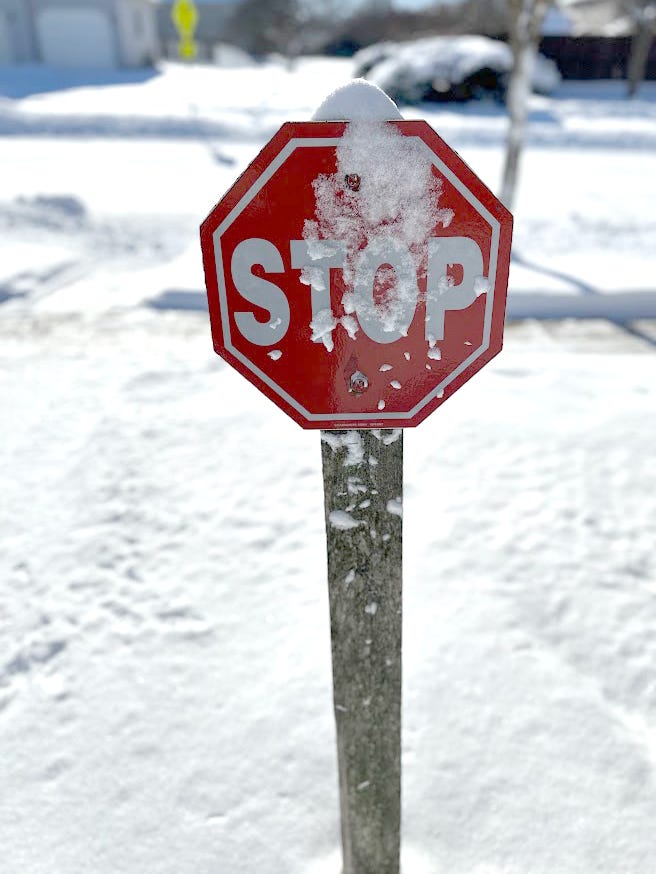
It occurred to me in that moment that stop signs aren’t really commands to stop forever. They’re pauses with purpose — reminders to take in what’s around us, check for risks, and then intentionally ease back into motion. That realization lodged itself in my mind, because it reflects so many moments in leadership when life hands us a sign and says:
Slow down. Pay attention. Proceed when ready.
The idea that stopping isn’t the same thing as quitting sounds obvious, but in practice it can feel surprisingly complicated. So many of us are wired for movement. Once we’re rolling, we don’t want to lose momentum. We don’t want to be the reason things slow down. We don’t want to feel like we’re drifting backward while everyone else speeds ahead. Stopping — even briefly — can feel like failure.
But stop signs aren’t failures. They’re safeguards. They’re perspective shifters. They’re invitations to transition from reacting to choosing.
Before going any further, let’s honor something important: stop signs that take the form of personal boundaries — ours or others’ — are not meant to be rolled through or gently negotiated. They are full stops. Non-negotiable. Meant to be respected every single time. Boundaries don’t ask us to proceed with caution; they ask us to adjust our behavior. They keep people safe, valued, and whole. There is no leadership without that respect.
But outside of those hard boundaries, most stop signs in leadership aren’t about blocking us; they’re about guiding us.
Leadership is full of intersections we don’t see coming. A reorganization. Shifting team dynamics. A talented colleague who suddenly withdraws. A project that inexplicably loses steam. A strategy that once worked beautifully and now falls flat. These pop up in our path — not to punish us, but to keep us from blowing into oncoming traffic.
I can think of plenty of times where my instinct, when something wasn’t working, was simply to press harder on the gas. Surely more effort, more intensity, more push would get things back on track. Except it didn’t. It rarely does. More speed in the wrong direction only gets you further from where you need to be. Stopping to pause long enough to understand the landscape has always been harder, but far more useful.
Stop signs tell us to look up from our point of focus and actually see what’s happening around us. Maybe there’s a blind curve we hadn’t noticed. Maybe another team is approaching from a different angle with ideas we haven’t considered. Maybe the road ahead is clear, but we aren’t. Maybe our team needs a moment of reassurance or clarity before moving forward.
The stop doesn’t solve anything on its own. But it creates visibility, and visibility is often what unlocks the next right step.
The funny thing is, in life and leadership, we’re sometimes tempted to treat stop signs in two extreme ways: we either slam on the brakes and never move again, or we treat them as gentle suggestions and do a rolling stop, barely glancing around before speeding ahead. Both approaches tend to backfire.
Lingering indefinitely at the intersection can look like overthinking, perfectionism, or fear of choosing the wrong route. We convince ourselves that if we just stay put a little longer, the answer will magically appear. Instead, we stagnate. Our team stagnates. And what was intended as a moment of safety becomes a self-imposed roadblock.
On the other hand, rushing the stop — only pausing long enough to check the box — means we miss the new information that could reshape our direction. We miss cues from people around us. We miss the subtle signs that the environment has changed and our old way of operating no longer fits.
The real magic is in the brief but intentional pause. The kind that’s long enough to see clearly, but not so long that we fear moving again.
This is where leadership earns its name. Because once we’ve paused, looked, and listened, something else is required: we have to go. Not recklessly. Not blindly. But forward.
The stop sign doesn’t invite us to build a house underneath it. It invites us to continue our journey with greater awareness. And that’s what many of our teams — and frankly, our own hearts — need from us. A willingness to slow down without giving up. A willingness to reflect without retreating. A willingness to reassess without assuming we’ve failed.
Stopping well is its own form of momentum.
The longer I sit with this realization, the more I think our leadership lives are less like highways and more like neighborhoods — full of intersections, full of potential hazards, full of opportunities to either connect with others or collide with them. Most of those interactions are made better by a thoughtful pause.
The moments where we choose to stop and look are the moments where emotional intelligence grows. Where empathy becomes possible. Where we notice the teammate who needs support, the blind spot we’ve been avoiding, or the path that’s safer and smarter than the one we were barreling down.
Stopping and then moving with intention is how we lead people to do the right things in the right way.
So the next time you feel halted in your path — by feedback, friction, change, or uncertainty — consider that maybe you’re not being told to quit. Maybe you’re being asked to pause, to check the intersection, to honor any boundaries you encounter, and then proceed with renewed clarity.