

Moving Toward Open Water
Breaking free from routine, reclaiming meaning, and letting our work move again

When my son started his first full-time job after college, I asked the question every parent asks.
How’s it going?
He told me he liked the work. He was learning a lot. The people were good, too. Then he paused and added something that surprised me a little more than I expected.
The days are already starting to blend together. Monday feels like Wednesday. Wednesday feels like Friday. It’s just… the same.
Without thinking too hard, I smiled and said,
Welcome to adulthood.
It was meant to be light. A half-joke. A knowing nod from someone who’s been there. But the more I sat with it, the more I realized how much truth was packed into my flippant response. Because for many of us, that blending of days is one of the earliest signals that work is shifting from something we actively engage with into something we simply endure. Not because it’s bad. Not because it’s wrong. But because it’s routine.
Routines are not the enemy. They’re necessary. They give structure to our days and predictability to our lives. They help us be efficient, competent, and reliable. But over time, routines can quietly become ruts. What once felt grounding can start to feel confining. The edges blur and our energy fades. We stop noticing the days because nothing about them feels distinct anymore.
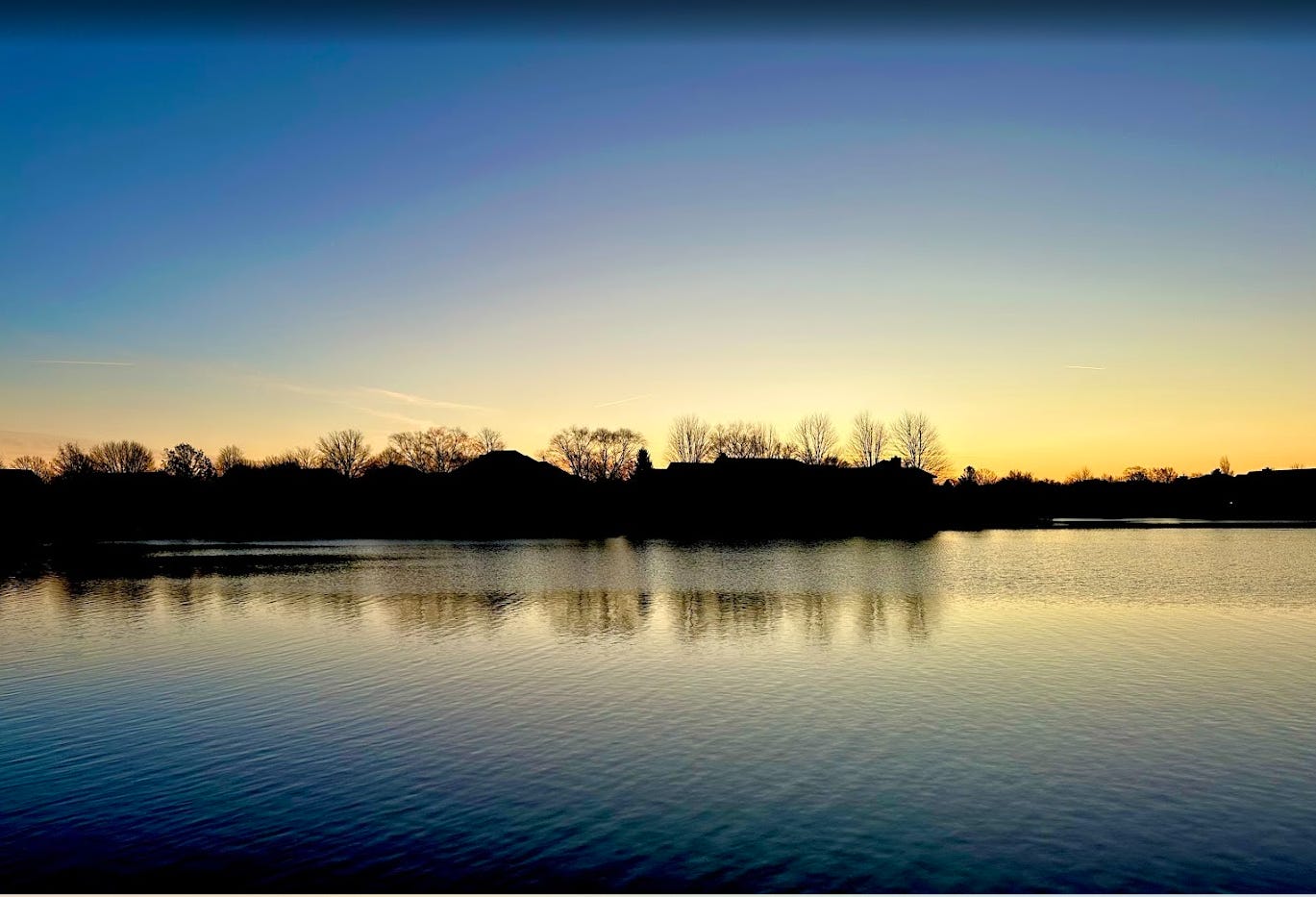
Today on my first morning walk of 2026, that thought was still rattling around in my head. I’ve got a few more days of winter break, but work is looming.
Did I have the mindset to come out of the gates running?
Winter arrived early this year — with the cold to match. The lakes near our house had been locked in ice for weeks. But after a week of warmer temps, the surface had finally given way. The ice had melted and the water was moving again, flowing freely, catching the light. It was a small shift, but it changed everything. And it struck me how closely that image mirrored how work often feels.
So much of professional life can feel like being trapped in the ice. Solid. Stable. Unmoving. We know the boundaries. We know the expectations. We know exactly how the days will unfold before they even begin. There’s safety in that, but there’s also stagnation. When nothing moves, nothing grows.
Most people don’t wake up one day and realize they’re stuck. It happens gradually. We get good at what we do, which is the point. But competence has a shadow side. When we stop being challenged, we stop being curious. When we stop being curious, we stop growing. The work becomes transactional. Time compresses. Weeks disappear without leaving much of a trace.
What makes this especially challenging is that being stuck doesn’t look like failure. Often, it looks like success. We’re busy. We’re productive. We’re meeting expectations. From the outside, everything appears fine. Inside, though, something feels frozen. There’s no forward motion, just repetition.
Open water, in contrast, is about movement. It’s about flow. It’s about feeling like what we do today matters in a way that is distinct from what we did yesterday. That doesn’t mean every day is exciting or easy. It means there is a sense of aliveness. A sense that our work is connected to purpose, learning, or contribution in a way that feels real.
Finding open water in our careers isn’t about escaping responsibility or abandoning routine. It’s about refusing to let routine be the whole story. It starts with awareness. Noticing when our days feel interchangeable. Noticing when we’re operating on autopilot. Noticing when we’ve stopped asking questions and started relying solely on answers we learned years ago.
From there, it becomes a practice of intentional movement. That movement might be internal before it’s external. Reframing how we see our role. Reconnecting with why the work matters to us personally, not just professionally. Allowing ourselves to care again, even when caring feels inefficient or risky.
There’s also courage involved. Open water can feel exposed. Ice is predictable. Flow is not. When we step out of our well-worn patterns, we risk discomfort. We risk failure. We risk discovering that something we’ve been clinging to no longer fits. But without that risk, nothing changes. We stay frozen, telling ourselves this is just how it is.
Leaders have a particular responsibility here. The way we experience work inevitably shapes how others experience it, too. When leaders treat drudgery as inevitable, it becomes cultural. When they model curiosity, growth, and meaning, those things become possible for others. The difference between a team that feels stuck and one that feels alive often comes down to whether open water is valued—or even acknowledged.
As I think about my son settling into this new rhythm of adulthood, I don’t want him to believe that blending days are the price of a stable life. I don’t want him to think that fulfillment is something you defer until nights, weekends, or retirement. I want him to know — and to see — that it’s possible to build a career that has structure without being frozen, routine without being lifeless.
The ice will always come. There will be seasons where work feels heavy, repetitive, or constrained. That’s unavoidable. But so is the thaw, if we’re paying attention. Open water is often closer than we think. It shows up when we choose movement over stagnation, curiosity over comfort, meaning over mere motion.
Adulthood doesn’t have to mean settling. A career doesn’t have to mean drudgery. Sometimes, it simply means recognizing when the ice has begun to crack — and having the awareness and courage to step toward the water that’s finally moving again.
As the calendar turns and we collectively lean into a new year, there’s a natural temptation to think in terms of big resolutions. Grand changes. Clean slates. But breaking out of professional routine rarely requires a dramatic reinvention. More often, it calls for small, intentional shifts that restore movement where things have quietly frozen.
The new year is an invitation to interrupt autopilot. To pause long enough to ask a few honest questions. Where have my days started to blur? What parts of my work feel most mechanical? Where am I operating out of habit rather than intention? These aren’t questions meant to induce guilt or dissatisfaction. They’re meant to surface awareness.
You can’t change what you refuse to notice.
Meaningful change usually begins with reclaiming agency. Routines have a way of convincing us that our days are fully spoken for, that there’s no room to maneuver. But there is almost always more choice than we acknowledge. Choice in where we place our energy. Choice in what we say yes to. Choice in what we’re willing to challenge, revisit, or let go. Even small adjustments — how we start our mornings, how we engage in conversations, how we approach familiar work — can reintroduce a sense of movement.
The new year is also a chance to experiment, not overhaul. Instead of asking, “What do I need to change about my career?” a more useful question might be, “What’s one way I can work differently?” One new behavior. One new boundary. One new way of showing up. Momentum doesn’t come from perfection; it comes from motion. And motion creates feedback that helps us learn what actually matters.
There’s something powerful about aligning change with intention rather than obligation. New Year’s resolutions often fail because they’re rooted in guilt or external expectations. Breaking out of routine, on the other hand, is about reconnecting with meaning. It’s about choosing growth because stagnation no longer feels acceptable. That’s a much more durable source of motivation.
As we step into a new year, the goal isn’t to eliminate routine entirely. Structure will always be part of work and life. The goal is to prevent routine from becoming a cage. To stay alert to the signs of freezing. To look for places where the ice is thinning and movement is possible.
The water is there. It always is. A new year simply gives us a convenient moment to notice it — and to decide whether we’re willing to move toward it.
Curiosity is the antidote to stagnancy. Sometimes life feels like we are stuck ice. Other times it feels like we are stuck in amber or sap. This has been one of those weeks where we have broken the patterns for just a few days and suddenly, we are all posting memes that say "I don't know what day it is." Is that not a testimony and also a travesty? I let go of the expectations this morning and slept in. I mean really slept in. The kind where the second sleep and the dreams that accompanied were vivid. It was surprising. And serene. And so overdue. I plan to spend time there for a while, while the tundra warms beneath my hands and beneath my words.
Shared. Resonated with everyone.